
People and Culture
BTRC Moves to Cut SIM Limit from 10 to 7 per Person Ahead of Election


The Bangladesh Telecommunication Regulatory Commission (BTRC) is moving to reduce the maximum number of SIM cards a person can own from 10 to 7, following an announcement by Home Affairs Adviser Jahangir Alam Chowdhury.
The regulator said it would soon send an official letter to the government seeking a final decision on the matter. The move comes shortly after a previous cap reduction—from 15 SIMs to 10 per person—took effect on November 1, leading to the deactivation of around 6.2 million SIMs.
Mobile operators have strongly opposed the new plan, warning that around 12 million users would lose 38 million active SIMs, costing the government approximately Tk 2,000 crore in annual revenue.
According to BTRC data, Bangladesh currently has 67.6 million users holding a total of 188.7 million SIMs. About 80% of subscribers have one to five SIMs, while 12 million people own between six and ten SIMs.
BTRC Chairman Maj. Gen. (Retd.) Emdad Ul Bari said, “There is no logical reason for a person to possess 10 SIMs. We will seek government approval to reduce the limit further.” He added that the commission is introducing a separate SIM series for IoT (Internet of Things) services.
However, telecom operators argue that the move will not stop fraud. Shahed Alam, Chief Corporate and Regulatory Affairs Officer of Robi, said, “The problem lies in national database breaches, not in how many SIMs people use.”
Taimur Rahman, his counterpart at Banglalink, said, “Instead of reducing SIMs, the focus should be on detecting and preventing fraudulent activities.”
In comparison, individuals in India can own up to 9 SIMs, Pakistan allows 5, and Maldives permits 10.
People and Culture
Ziaur Rahman from captivity to the center of power: The turbulent chapter of 7 November


Why it matters: 7 November 1975 is a turning point in the history of Bangladesh, which not only ensured the release of Ziaur Rahman from captivity but also permanently altered the country’s power equation. This event played a major role in laying the foundation for the political and military structure of modern Bangladesh.
The big picture: After Ziaur Rahman was imprisoned during Khaled Mosharraf’s coup on 3 November, extreme chaos erupted within the army. On the night of 6 November, the ‘Biplobi Sainik Sangstha’ (Revolutionary Soldiers’ Organization), led by Colonel Taher and JSD, staged a counter-coup, resulting in the release of Ziaur Rahman and the deaths of several high-ranking officers, including Khaled Mosharraf.
Between the lines: JSD and Colonel Taher had hoped that Ziaur Rahman would support their revolutionary agenda and the implementation of their 12-point demand. However, after his release, Ziaur Rahman focused on restoring discipline within the cantonment and took a stance against JSD’s revolutionary plans, which was perceived as ‘betrayal’ by JSD.
What’s next: Ziaur Rahman quickly restored command and discipline in the army and moved to the center of state power as the Deputy Chief Martial Law Administrator. Subsequently, Colonel Taher was brought to trial and sentenced to death in 1976, a matter that remains one of the most significant topics of political debate in Bangladesh today.
The bottom line: While the events of 7 November paved the way for Ziaur Rahman’s political rise, they also gave birth to a long-standing political polarization in the name of restoring discipline in the army, which remains divided to this day as ‘National Revolution and Solidarity Day’ versus ‘Freedom Fighter Killing Day’.
People and Culture
Sleeping to success: Mumbai’s Zinia wins 9.6 lakh rupees as India’s ‘Sleep Champion’

Why it matters: At a time when people are overwhelmed by insomnia and the pressures of professional life, Zinia Chatterjee from Mumbai has won 9.6 lakh rupees by demonstrating the skill of sleeping in an organized manner. This unique ‘Sleep Internship’ competition, organized by the popular Indian sleep solutions brand ‘Wakefit’, has brought the importance of sleep back into the spotlight.
The big picture: From over two lakh applicants across India, 10 finalists were selected through a rigorous screening process. In this 60-day competition, participants had to go through not only sleep routines but also complex stages like creative weekly challenges and tracking sleep performance.
Between the lines: The competition was not limited to just sleeping; it included quirky intellectual and creative tasks such as ‘Sleep Cinema’, ‘Sleep Bingo’, and ‘Undercover Sleep Mission’. In the grand finale, participants’ observational skills and ability to create a sleep environment were tested through the ‘Memory Foam Challenge’ and ‘Sleep Auction’, where Zinia Chatterjee proved her excellence.
What’s next: Following the unprecedented success of this competition, Wakefit authorities have already started pre-registration for their sixth season. Initiated in 2019, this venture has attracted over 10 lakh applicants to date and rewarded 65 interns, becoming a major platform for raising awareness about sleep quality in the future.
The bottom line: By winning 9.6 lakh rupees and a sponsored vacation package, Zinia Chatterjee has proven that disciplined sleep in modern life can be an important component not only for health but also for career and success. This victory is being considered a unique example of generating interest and awareness about sleep hygiene among the general public.
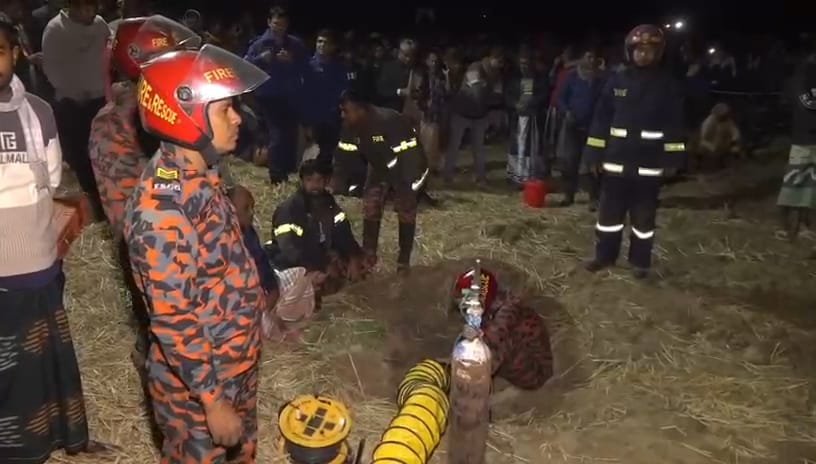
Rajshahi, December 11:
A tense, round-the-clock rescue operation is underway in Tanore Upazila of Rajshahi to save two-year-old Sajid, who fell into a 40-foot deep abandoned borehole. The child accidentally slipped into the open pit while walking behind his mother near their home in Koyeler Hat Madhyapara on Wednesday (December 10) around 1:00 PM.
As of Thursday morning, Sajid remains trapped in the dark, cold, and suffocating pit, with no sight of him. The rescue efforts have surpassed 20 hours.
The mother, Runa Begum, recounted the moment of the accident: Sajid was holding her hand as they walked in a field next to their home to collect hay. The borewell was hidden under a layer of hay, making it invisible. Sajid fell instantly upon stepping on the spot.
“My son called out ‘Maa, Maa’ three or four times, and then… silence,” said the grief-stricken mother, who has spent the night waiting by the pit, frequently losing consciousness due to shock and distress. She added that Sajid had a high fever and is now suffering in the intense cold underground.
The Fire Service was alerted after local attempts failed. Five units were deployed, but the initial phase was delayed due to the unavailability of a high-powered excavator in the entire Tanore Upazila. Eventually, two smaller excavators were brought from the adjacent Mohanpur Upazila around 8:00 PM to begin digging parallel to the borewell.
By 6:00 AM on Thursday, the Fire Service had dug a 40-foot deep parallel pit. Workers then started digging a connecting tunnel towards the main borewell where Sajid is trapped. Although tunneling has been underway for over an hour and a half, the child has not yet been reached.
Local residents confirmed that the pit was dug about a year ago by the landowner, Kochhir Uddin, for a semi-deep tube well but was left open after failing to find water, leading to the tragedy.
Didarul Islam, Assistant Director of the Rajshahi Fire Service Station, stated that the rescue work is ongoing, focusing on the careful tunneling to reach the child.
-

 Crime and Justice23 hours ago
Teenager killed after losing control of motorcycle and hitting palm tree in Kushtia’s Daulatpur
-

 ISLAM13 hours ago
Nusuk app offers opportunity to perform Umrah for free
-

 Crime and Justice23 hours ago
Bangladeshi national injured and detained by BSF in Chuadanga border shooting
-

 Bangladesh10 hours ago
High Court reinstates Adhunagar Union Parishad chairman Nazim Uddin in Lohagara
-

 Politics15 hours ago
Jatiya Nagorik Party holds inauguration and political showdown in Lohagara